Hours, directions, entrances, and the best time to arrive
Nausicaá National Sea Centre visitor guide
Nausicaá National Sea Centre is a large, mission-led aquarium in Boulogne-sur-Mer, best known for its huge High Seas tank and ocean-focused exhibitions that go beyond fish displays. This is a long, multi-zone visit rather than a quick walk-through, and timing matters more than people expect because midday crowding quickly affects the tunnel and main viewing areas. This guide covers the best arrival window, route, ticket choices, and what to prioritise once you’re inside.
Quick overview: Nausicaá at a glance
If you want the smoothest visit, make three decisions first: when to arrive, how long to stay, and whether you want just the highlights or the full route.
- When to visit: Daily, 9:30am–6:30pm. The first entry at 9:30am or a late-afternoon visit after 3pm is noticeably calmer than 11am–2pm, because that’s when school-holiday and weekend crowds bunch up around the High Seas tunnel and main viewing window.
- Getting in: From €30.50 for standard adult entry. Premium feedings, behind-the-scenes visits, and themed tours cost extra, and booking ahead matters on weekends, bank holidays, and school vacations because Nausicaá can delay access once capacity is reached.
- How long to allow: 3.5–5 hours suits most visitors. It stretches longer if you add the Abyss exhibition, feedings, family activities, or a second slow pass through the big viewing areas.
- What most people miss: The 2024 ‘Journey into the Abyss’ exhibition and the climate interpretation route are easy to rush past, even though both add the context that makes the animal displays feel more meaningful.
- Is a guide worth it? Yes for visitors who want the conservation story and premium animal talks; for a standard visit, a self-planned route works well if you already know which zones matter most to you.
🎟️ Tickets for Nausicaá sell out days in advance during French school holidays and long weekends. Lock in your visit before the time you want is gone. See ticket options
Jump to what you need
🕒 Where and when to go
🗓️ How much time do you need?
Visit lengths, suggested routes, and how to plan around your time
🎟️ Which ticket is right for you?
Compare all entry options, tours, and special experiences
🗺️ Getting around
How the galleries are laid out and the route that makes most sense
🐠 Which animals to prioritise
Oceanic manta ray, blackchin guitarfish, and the High Seas tank
♿ Facilities and accessibility
Restrooms, lockers, accessibility details, and family services
Where and when to go
How do you get to Nausicaá?
Nausicaá sits on Boulogne-sur-Mer’s seafront, close to the marina and about 1.5km from the old town, with Boulogne-Ville station as the main rail arrival point.
Boulevard Sainte-Beuve, 62200 Boulogne-sur-Mer, France
- Train + bus: Boulogne-Ville station → bus line F → about 10 minutes → easiest option if you don’t want the uphill walk from the station.
- Train + walk: Boulogne-Ville station → about 30-minute walk → workable in good weather, but less appealing with children or after rain.
- Car: A16 access → nearby seafront car parks → short walk → useful for families, but spaces feel tighter on holiday weekends.
- Bike: EuroVelo 4 access → marina and seafront approach → good option if you’re already staying on the Opal Coast.
Which entrance should you use?
Nausicaá works more like a single main-entry attraction than a multi-gate site, so the main mistake is arriving at the busiest time and expecting fast access without a prebooked ticket.
- Main entrance: Located on Boulevard Sainte-Beuve. Best for all visitors. Expect the slowest access around late morning and early afternoon on weekends, bank holidays, and school holidays.
When is Nausicaá open?
- Monday–Sunday: 9:30am–6:30pm
- December 25: Closed
- January 1: Reduced opening hours
- Annual closure: January 5–31
- Last same-day ticket office sales: 5pm
When is it busiest? Weekends, bank holidays, and French school vacations are busiest, especially from 11am–2pm, when entrance delays and crowded sightlines around the High Seas route are most noticeable.
When should you actually go? Be there at 9:30am or after 3pm, because Nausicaá itself flags these windows as the easiest way to avoid the worst congestion.
How much time do you need?
| Visit type | Route | Duration | Walking distance | What you get |
|---|---|---|---|---|
Highlights only | Entrance → High Seas tank → tunnel → main viewing window → Abyss → exit | 2–2.5 hours | ~1km | You get the signature pelagic experience and deep-sea add-on, but you’ll skip most coastal, tropical, and climate interpretation areas. |
Balanced visit | Entrance → High Seas → Abyss → In the Eye of the Climate → Mankind and Shores → Tropical Getaway → exit | 3.5–4.5 hours | ~2km | This gives you the big tank, the climate storyline, and the stronger family-friendly galleries without feeling rushed. |
Full exploration | Entrance → High Seas → feedings or viewpoints → Abyss → Climate → Mankind and Shores → Tropical Getaway → sea lions, touch areas, and family stops → exit | 5+ hours | ~3km | You cover the full site at a comfortable pace, but it’s a long indoor day and crowd-heavy periods make the final galleries harder to enjoy if you start late. |
Which Nausicaá ticket is best for you
| Ticket type | What's included | Best for | Price range |
|---|---|---|---|
Standard day ticket | General admission to Nausicaá’s permanent routes | A first visit where you want the main aquarium experience without committing to premium add-ons | From €30.50 |
Second-day extension | Extra day added to a standard visit | A long or family visit where you’d rather split the route across 2 lighter days than rush everything in 1 | From €5 |
Annual pass | Unlimited access across the year | Repeat visits where you want to return for seasonal changes, new exhibits, or a slower second pass through busy galleries | From €50 |
Behind-the-scenes visit | General admission + premium backstage experience | A visit where the animal care and husbandry side matters as much as the public galleries | |
Feeding or themed activity add-on | General admission + booked feeding, family activity, or themed shark experience | A visit that feels too passive unless you build in a scheduled activity at a fixed time |
How do you get around Nausicaá?
Aquarium layout
Nausicaá is a large, zone-based aquarium rather than a single straight route, with the High Seas galleries acting as the dramatic anchor and the coastal, tropical, and climate sections adding most of the context. In practice, that means it’s easy to overstay in the first giant tank areas and short-change the later galleries.
- Journey on the High Seas: Giant pelagic tank, tunnel, viewing window, and Malpelo storyline → budget 60–90 minutes.
- Journey into the Abyss: Deep-sea species, hydrothermal-vent interpretation, and Ifremer collaboration → budget 20–30 minutes.
- In the Eye of the Climate: Immersive climate route with scenography and penguin storylines → budget 25–40 minutes.
- Mankind and Shores: North Sea, Mediterranean, mangroves, coral reef, touch areas, and family-focused exhibits → budget 60–90 minutes.
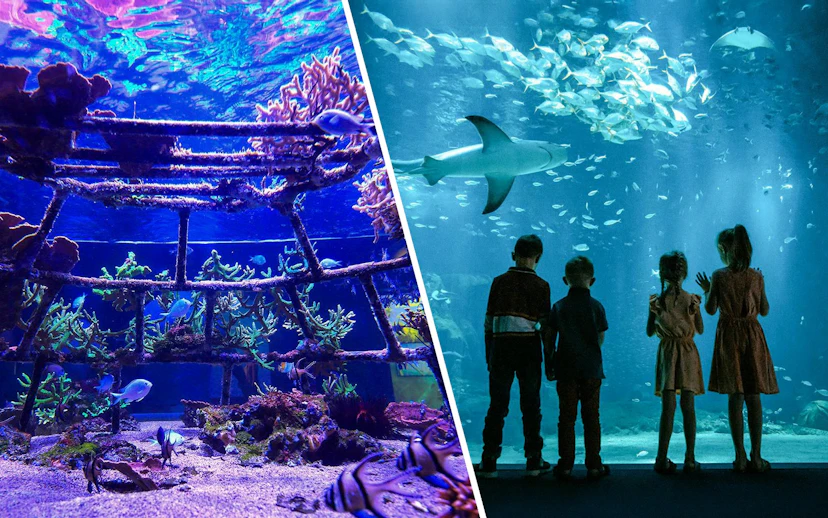
- Tropical Getaway: Renewed coral-ecosystem zone with lagoon, reef-flat, and mangrove environments → budget 30–45 minutes.
Suggested route: Start with High Seas as soon as the doors open, then do Abyss while you’re already in that part of the site, move on to Climate before lunch, and save Mankind and Shores plus Tropical Getaway for later. What many visitors miss is that the climate and abyss sections explain the rest of the aquarium, not just supplement it.
Maps and navigation tools
- Map: On-site route maps and Nausicaá’s route pages cover the main zones → pull up the route overview on your phone before arrival.
- Signage: Good enough for a basic self-guided visit, but a saved route plan helps because the visit is thematic rather than purely linear.
- Audio guide / app: No standalone audio guide is highlighted in the current English visitor info → live talks and exhibit text do most of the explaining.
💡 Pro tip: Screenshot the route pages before you enter. Once you’re inside the big viewing areas, it’s easy to lose track of what still lies ahead and accidentally skip the climate and abyss sections.
Which animals and habitats should you prioritise?

1/7
High Seas tank
Habitat: Pelagic open-ocean ecosystem
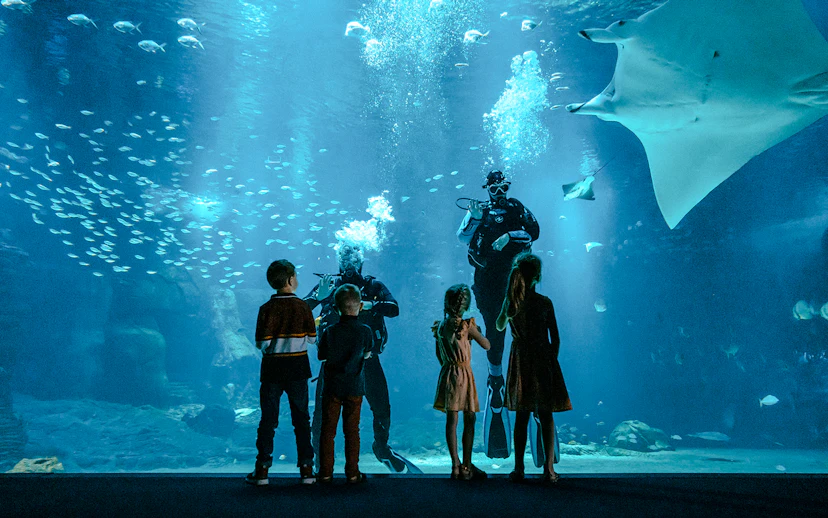
This is the emotional center of the visit: a huge Malpelo-inspired tank with sharks, rays, and schooling fish moving through a genuinely large field of view. What most people miss is that the upper viewpoints change the whole experience — the main window is impressive, but it is not the only worthwhile stop.
Where to find it: Inside the ‘Journey on the High Seas’ route, around the tunnel and main Great Ocean Show viewpoints.
Oceanic manta ray
Species: Oceanic manta ray
Nausicaá’s manta ray is one of the standout animal encounters here because of the scale — the center’s own material puts it at around 4m across. Most visitors look for it only from the tunnel, but the broader viewing window gives you a much better sense of how it moves through the water column.
Where to find it: In the High Seas tank, best viewed from the large front window after the tunnel.
Blackchin guitarfish
Species: Critically endangered ray
This is one of the most important conservation stories in the building, not just another unusual fish. Nausicaá coordinates a European ex situ program for the species, and that backstory is easy to miss if you focus only on the giant tank spectacle.
Where to find it: Within Nausicaá’s ray and shark-focused displays, especially in the conservation-linked sections tied to breeding work.
Journey into the Abyss
Habitat: Deep-sea exhibition
Opened in 2024 with Ifremer, this permanent exhibition adds a different mood to the visit: darker, slower, and more science-heavy than the main aquarium spaces. Many visitors rush it because it feels smaller than High Seas, but it is where Nausicaá becomes most distinctive on current ocean policy and deep-sea mining.
Where to find it: Integrated into the wider High Seas route.
Tropical Getaway
Habitat: Coral lagoon, reef flat, and mangrove ecosystems
The 2025 tropical relaunch gives the visit a brighter, more classic aquarium finish after the deeper blue tones of the earlier galleries. What visitors often miss is that it’s not just decorative — it also shows the coral and coastal systems that Nausicaá ties to breeding and restoration work.
Where to find it: In the renewed tropical zone toward the later part of the visit.
African penguins
Species: African penguins
These are more than a family favorite here; they also anchor part of the climate story in a way children can understand quickly. The easy thing to miss is the interpretive link between the animal habitat and the neighboring climate messaging, which makes this stop more than just a cute photo break.
Where to find it: In the climate-linked section of the route.
Sea lions
Species: California sea lions
These are one of the liveliest parts of the family route and a good reset after the darker aquarium galleries. Visitors often treat them as a quick stop, but they work best if you slow down long enough to watch behavior rather than moving on after the first splash.
Where to find it: In the ‘Mankind and Shores’ route.
Facilities and accessibility
- 🎒 Cloakroom / lockers: Lockers are available, which helps if you’re carrying coats, children’s gear, or anything you don’t want to haul through a 4-hour visit.
- 🚻 Restrooms: Restrooms are available throughout the site, and accessible toilets are distributed across the center rather than being limited to the entrance area.
- 🍽️ Cafes and restaurants: Calypso self-service cafeteria and Bistrot Côté Plage cover quick meals and sit-down breaks, so you don’t need to leave the site just to eat.
- 🛍️ Gift shop / merchandise: There is an on-site shop for marine-themed souvenirs and educational items, which makes more sense as an end-of-visit stop than a mid-route detour.
- 📶 Wi-Fi: Free Wi-Fi is available, which is useful if you want to keep the route pages open or pull up tickets on your phone.
- 🩺 First aid / medical station: An infirmary is available, which matters on a long indoor visit with younger children.
- ♿ Mobility: Lifts give access to nearly all of the High Seas and Mankind and Shores routes, and accessible toilets are available throughout the center.
- 👁️ Visual impairments: Guide dogs are allowed, and the main practical help point is the front-of-house team rather than a separate visual-access desk.
- 🧠 Cognitive and sensory needs: No dedicated sensory hours are highlighted in the current visitor info, so the calmest windows are still opening time and after 3pm.
- 👨👩👧 Families and strollers: Compact pushchairs are available to hire, baby carriers are on loan, and the route is easier with a stroller than many historic attractions because it relies on lifts and broad circulation spaces.
Nausicaá works well for children because the visit mixes large-animal spectacle, hands-on moments, and enough movement between zones to break up attention spans.
- 🕐 Time: 2.5–4 hours is realistic with young children, and the safest priorities are the High Seas tunnel, sea lions, penguins, and touch-focused areas.
- 🏠 Facilities: Baby-changing tables, games areas, stroller hire, baby carriers, and an infirmary make this easier than a typical long museum-style visit.
- 💡 Engagement: Use the giant tank first, because it sets the emotional hook early and makes children more patient with the climate and deeper science sections later.
- 🎒 Logistics: Bring only the basics, arrive at 9:30am if you can, and avoid planning your first stop around lunch because that is when the building feels most crowded.
- 📍 After your visit: Boulogne-sur-Mer beach is the simplest child-friendly follow-up, especially if you need fresh air after a long indoor visit.
Rules and restrictions
What you need to know before you go
- Entry requirement: A dated ticket is the safest way in during school holidays and long weekends, because online booking is the only way Nausicaá says it can guarantee entry in peak periods.
- Bag policy: Travel light if you can, because this is a long indoor visit and lockers are available for anything you don’t want to carry all day.
- Re-entry policy: Check the current rule at admission if you plan to step out, because the published visitor info focuses on capacity management rather than flexible same-day re-entry.
Not allowed
- 🐾 Pets: Standard pets are not part of the visit, but guide dogs are allowed.
- 🖐️ Touching exhibits: Use touch areas only when invited to do so, because the rest of the galleries are hands-off for animal welfare and exhibit protection.
Photography
The current English visitor information does not highlight a broad photo ban, so most visitors treat personal photography as part of the visit. If you plan to use flash, a tripod, or filming gear, check at the entrance first, because aquarium rules often tighten around animal welfare, crowd flow, and professional-style equipment.
Good to know
- Some premium visits and family activities are listed only in French, so check the language before you book an add-on.
- On peak days, the biggest frustration is not finding the exhibits — it’s losing clear views once the High Seas route gets crowded.
Practical tips
- Book ahead for weekends, bank holidays, and French school vacations, because Nausicaá warns that entry can be delayed once capacity is reached and online tickets are the safer choice.
- Arrive at 9:30am or after 3pm; those are the center’s own recommended low-friction windows, and they matter most around the High Seas tunnel and main viewing glass.
- Do the High Seas route first, not last, because it is the part of the aquarium that loses the most once crowds build and sightlines get blocked.
- If you want the full experience without rushing children or skipping climate and deep-sea sections, the €5 second-day add-on is better value than trying to cram everything into 1 tired afternoon.
- Keep your bag small, because this is a long indoor route and a bulky backpack becomes annoying fast even if lockers are available.
- Eat either before you enter or after your first major route, because a lunch stop in the middle of the busiest window breaks your rhythm and drops you back into the thickest crowds.
- If you’re booking a premium activity, check the language carefully; some themed visits and family activities are not consistently presented in English.
- Save 20–30 minutes for ‘Journey into the Abyss’ even if you’re short on time, because it is one of the clearest things that separates Nausicaá from a more standard large aquarium.
What else is worth visiting nearby?
Commonly paired: Boulogne-sur-Mer beach
Boulogne-sur-Mer beach
Distance: Opposite / 2-minute walk
Why people combine them: It is the easiest same-day pairing — you can step straight from a long indoor aquarium visit onto the seafront for fresh air and a much needed reset.
Book / Learn more
Commonly paired: Notre-Dame Basilica and crypt
Notre-Dame Basilica and crypt
Distance: About 1.6km — 20-minute walk
Why people combine them: It gives the day some contrast — marine life and conservation first, then Boulogne’s historic core and one of the city’s strongest heritage stops.
Book / Learn more
Also nearby
Boulogne-sur-Mer old town
Distance: About 1.5km — 20-minute walk
Worth knowing: This is the best nearby add-on if you want cafes, old streets, and a slower post-aquarium wander without leaving the city.
Château-Musée de Boulogne-sur-Mer
Distance: About 1.7km — 22-minute walk
Worth knowing: It is a better fit than the beach if the weather turns, and it pairs well with the old town rather than as a stand-alone detour.
Eat, shop and stay near Nausicaá
- On-site: Calypso self-service cafeteria and Bistrot Côté Plage cover the practical choice between quick cafeteria food and a longer sit-down break; they’re convenient, but they make the most sense outside the noon rush.
- Hôtel Opal’Inn (opposite Nausicaá, Boulevard Sainte-Beuve): Best if you want the shortest possible walk back after a long visit or an early start the next morning.
- Hôtel La Matelote (opposite Nausicaá, Boulevard Sainte-Beuve): A better pick for a slower meal or a more polished overnight stay right by the entrance.
- Old town and seafront cafes (15–20-minute walk, Boulogne-sur-Mer center): Better value than eating at peak time inside the attraction, especially if you are combining Nausicaá with the beach or old town.
- Pro tip: If you’re visiting on a busy day, eat late rather than at noon — you’ll dodge the thickest indoor crowds and get a calmer run through the High Seas galleries first.
- Nausicaá shop: Marine-themed gifts, children’s books, and educational souvenirs are the obvious buys here, and it is best left until the end of the route.
- Boulogne-sur-Mer old town shops: If you want local rather than aquarium-branded souvenirs, save your shopping for the old town after the visit.
If your priority is Nausicaá itself, staying nearby is worth it. The seafront is practical, walkable, and easy for a short break centered on the aquarium, but it is a less compelling base than bigger French coastal cities if Nausicaá is only one stop on a longer trip.
- Price point: The immediate area leans from straightforward mid-range seafront stays to a few more polished options opposite the center.
- Best for: Short breaks, families who want a simple walk to the entrance, and anyone planning to use the second-day extension.
- Consider instead: Boulogne-sur-Mer old town works better if you want more atmosphere and restaurants, while wider Opal Coast bases make more sense for a longer coastal road trip.
Frequently asked questions about visiting Nausicaá
Most visits take 3.5–5 hours, though you can do the core highlights in about 2–2.5 hours. The High Seas route absorbs more time than people expect, and the sections most often rushed are the climate galleries and the newer ‘Journey into the Abyss’ exhibition.
Yes, booking ahead is the safer move on weekends, bank holidays, and during French school vacations. Nausicaá says online booking guarantees entry in peak periods, while same-day access can be delayed once the building reaches capacity.
Not usually — the bigger win is booking online and choosing the right time slot rather than paying for a generic fast-track idea. Nausicaá’s main pain point is crowding and capacity at busy hours, not a maze of separate interior lines once you are inside.
Arrive 15–20 minutes early, and aim for the 9:30am opening slot if you want the easiest visit. On busy days, Nausicaá itself recommends opening time or after 3pm, because late morning and early afternoon are the most crowded.
Yes, but a small bag is much easier than a large backpack on a long visit. Lockers are available, and traveling light matters here because you can easily spend half a day moving between large viewing areas, family zones, and immersive exhibitions.
Personal photos are usually part of the visit, but check current rules at entry if you plan to use flash, a tripod, or filming gear. The published English visitor info does not highlight a broad photo ban, but aquarium-specific restrictions can still apply around animal welfare and crowd flow.
Yes, group visits are well supported, especially for schools and organized educational trips. Nausicaá offers mediator-led activities, practical services for group arrivals, and even shorter routes for tighter schedules, which makes it easier to plan for limited time windows.
Yes, Nausicaá works well for families, especially if you focus on the giant tank, tunnel, sea lions, penguins, and hands-on areas first. The mix of spectacle and movement between zones helps children stay engaged longer than in a purely text-heavy museum.
Mostly yes — lifts provide access to nearly all of the High Seas and Mankind and Shores routes. Accessible toilets are available throughout the building, so the main issue is usually crowd pressure at busy times rather than a lack of route access.
Yes, you have both on-site and nearby options. Inside the center, there is the Calypso self-service cafeteria and Bistrot Côté Plage; outside, the seafront and old town give you more breathing room if you’d rather eat after the visit.
Not always — some animal feedings and themed activities are separate bookable add-ons. That matters if you are building your day around a specific experience, because standard admission alone does not automatically include every premium activity.
Not always, so you should check the language before booking. Nausicaá’s own activity pages are not always translated consistently, and some premium experiences are clearly labeled for French-speaking visitors first.